


XLR


The Cadillac XLR is one of the most fascinating, beautifully over-engineered anomalies in modern American automotive history. It was a bold, unapologetic roll of the dice from General Motors, and looking back at it now, it has aged like fine wine.

The Gran Turismo with Corvette DNA
Cadillac did not develop the XLR in isolation. The program used Corvette manufacturing expertise and a performance-car architecture with hydroformed structural elements, a rear transaxle layout, rear-wheel drive, and independent suspension. Yet Cadillac specified its own bodywork, interior, Northstar engines, electronic systems, suspension calibration, and refinement targets. Where a Corvette was openly mechanical and track-focused driver-forward, the XLR was meant to be quieter, more formal, and more technologically demonstrative.
In other words the XLR never wanted to be a Corvette.
It was a long legged roadster from day one.
Built in a pure GT.

Chassis, Body and Engineering Architecture
The XLR’s engineering foundation came from GM’s two-seat sports-car world. It used a front-engine, rear-transaxle layout for favorable weight distribution and a low seating position, with independent suspension at all four corners. The body panels were unique to Cadillac, and the powered retractable hardtop transformed the car from closed coupe to open roadster without resorting to a fabric roof.
Magnetic Ride Control was central to the XLR’s character. The system used magnetorheological dampers capable of rapid adjustment, giving Cadillac engineers the ability to tune a car that could feel composed and calm in touring use while remaining controlled at speed. It was one of the most important technologies on the XLR, and one of the features that separated it from a conventional luxury convertible.
50/50


The Core Skeleton: Incredibly Solid
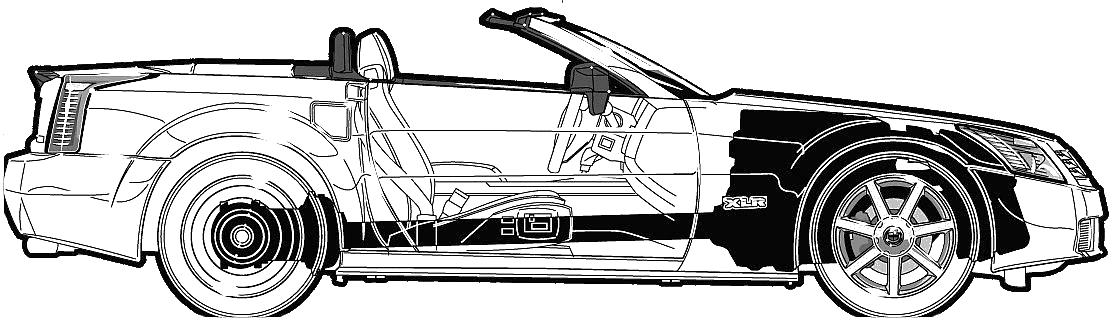
Because the XLR was built on GM's performance Y-body architecture (shared with the Corvette), its underlying frame is exceptionally rigid. Traditional convertibles often suffer from "cowl shake"—where the car flexes and twists over bumps because it lacks a solid roof. The XLR completely avoids this thanks to a high-strength structural blueprint: Hydroformed Steel Side Rails: The perimeter of the frame is made of massive, seamless tubes of steel blasted into shape with high-pressure water, providing incredible torsional stiffness. The Center Backbone: A heavy, enclosed, folded steel tunnel runs down the center of the car like a spine, locking the front and rear halves together. Space-Age Floor Pans: The floors are a composite sandwich of aluminum and ultra-lightweight balsa wood, designed to damp out road vibrations before they hit your seat. Fundamentally, you cannot twist or bend this chassis; it is an incredibly robust foundation.
The Mechanical Core: A Traditional LSD
Instead of electronics or clutch packs in the differential adjusting torque side-to-side on the fly, the XLR and the high-performance XLR-V rely on a traditional, purely mechanical Limited-Slip Differential (LSD). How it works: If one of your rear tires starts losing traction (like when you accelerate hard out of a corner), the mechanical clutches inside the differential bind up, sending power to the wheel with the most grip. It keeps the rear stable, but it is a reactive mechanical system rather than an active handling booster. Electronic limited-slip differentials (eLSD) and advanced torque vectoring didn't really show up in the GM performance family until later generations, like the C7 Corvette and modern V-Series heavy hitters like the CT5-V Blackwing. For the XLR, it’s all classic mechanical grip backed up by space-age magnets in the shocks!
The Cadillac XLR's Number
When car designers talk about a vehicle's structure in Hertz (Hz), they are referring to its global resonant frequency—specifically, how stiff it is under dynamic twisting (torsion) and bending forces. Think of the entire car chassis as a giant tuning fork. When the car hits a pothole or goes around a sharp corner, the frame flexes and vibrates at a specific frequency. Understanding the "Hz" numbers reveals the target goals of automotive engineers: The Danger Zone (10–15 Hz): Tire movements, suspension travel, and wheel hop naturally vibrate in this lower range. If the car's frame also has a natural frequency in this zone, the vibrations match up and magnify. This causes a nasty, structural shudder known as cowl shake, which makes the steering wheel and dashboard rattle over bumps. The Stiff Target (20+ Hz): To keep a car feeling premium, quiet, and solid, engineers fight to push the chassis' natural frequency well over 20 Hz. The higher the Hertz number, the stiffer the body, and the better the suspension can do its job without the car bending. The Cadillac XLR chassis achieves a natural frequency of 21 to 23 Hz.
Y
It is widely known that the XLR shared its structural bones (the Y-body architecture) and its Bowling Green, Kentucky assembly line with the Chevrolet Corvette C6. Because of this, people often casually called it a "luxury Corvette." However, Cadillac went out of its way to ensure it drove completely differently. While the Corvette was built for raw, tail-happy sports car metrics, the XLR was engineered as a high-speed, long-distance Grand Tourer—prioritizing effortless poise, stability, and high-speed sweepers over track aggression.
The Suspension
For a low-slung car, the XLR handles uneven, broken pavement shockingly well due to its Magnetic Ride Control (MRC) suspension. The shock absorbers are filled with a specialized fluid containing tiny iron particles. Onboard sensors monitor the wheel travel 1,000 times every single second. The moment a tire hits a harsh pothole or a patch of rough asphalt, an electromagnetic charge instantly thins the fluid to soften the shock and absorb the impact. A millisecond later, it firms the shock back up so the car stays perfectly flat and composed. On undulating, poorly maintained country roads, it glides along with a level of poise that standard mechanical springs simply cannot match.
The Safety Net: StabiliTrak
Stability Control (StabiliTrak): It is a safety system. If the car senses you are skidding or sliding out of control, it will selectively squeeze the brake on an individual wheel to straighten the car out. It subtracts energy to keep you safe.
Why This Score Was a Big Deal
For a luxury convertible with a folding hardtop, hitting 21–23 Hz was an incredible engineering achievement. When you slice the roof off a car to make it a convertible, you typically destroy its structural rigidity, dropping the frequency deep into the "danger zone" teens. Usually, engineers have to weld heavy steel plates under the floorboards to compensate, making the car heavy and sluggish. Because GM designed the platform from day one to be an open-top roadster, the XLR utilized a massive, enclosed center backbone tunnel and seamless perimeter frame rails (which you can see running the length of the vehicle in the cutaway visual above). This unique layout allowed the XLR to hit sports-sedan levels of structural stiffness without adding heavy steel reinforcements, effectively eliminating cowl shake and giving it a solid ride.

4.6
VVT
5.9
V8
LH2
14.2
32
325
250
DOHC
420
1653
It Rejected the Corvette's Engine
To give the XLR its own distinct, upscale identity, Cadillac refused to use Chevrolet's pushrod LS V8 engine. Instead, they re-engineered their own premium 4.6-liter 32-valve DOHC Northstar V8 specifically for this car, marking the very first time the Northstar engine was adapted for a longitudinal rear-wheel-drive layout. It delivered a completely different, high-revving European exhaust note compared to the deep, low-end rumble of a Corvette.
The Cadillac XLR was never a simple rebodied Corvette, though that shorthand has followed it from the beginning. It was built in Bowling Green, Kentucky, beside the Corvette and drew from GM’s Y-body sports-car architecture, but its brief was distinctly Cadillac: a polished, technology-led luxury roadster aimed at the Mercedes-Benz SL rather than the club-racing paddock. The result was one of the more unusual halo cars of the period—a sharp-edged, Northstar-powered retractable hardtop that combined Corvette structural thinking with Cadillac’s Art and Science design language.

The Italian Luxury Touch (Bulgari)
Cadillac wanted the interior to scream high-end luxury rather than parts-bin corporate styling. To achieve this, they partnered with the iconic Italian luxury jewelry and watch house, Bulgari (Bvlgari). Bulgari didn't just give styling notes; they specifically designed the minimalist instrument cluster graphics, the interior font layout, and even the custom luxury key fob to make the cabin feel entirely bespoke.
Cadillac wanted the driver’s primary touchpoints to feel like high fashion rather than standard corporate parts.
The Instrument Cluster: The gauges were co-designed with the Italian luxury jeweler Bulgari. The typography, the subtle layout of the numbers, and the brushed metallic rings around the dials were modeled directly after the face of a premium Bulgari wrist watch.
The Key Fob: Even the proximity key fob featured a distinctive, weighted Bulgari design insert to mimic a piece of personal jewelry in the owner's pocket.

BVLGARI

B&O


The Bang & Olufsen Interior Rule
During the late 1990s and early 2000s, B&O was the gold standard for minimalist, premium product design, characterized by straight lines, real metals, and hidden mechanical operations.
The Interior Architecture: The vertical center stack, the rectangular layout of the buttons, and the flush integration of the exotic light eucalyptus wood trim were drawn directly from the design language of luxury European audio systems. The team wanted the cabin to feel like a high-end architectural space rather than a chaotic cockpit.Instead of looking at other car interiors for inspiration, the XLR’s interior designers studied high-end, minimalist home architecture and premium Danish electronics—specifically Bang & Olufsen audio equipment.
Traditional luxury car dashboards of the early 2000s were full of soft, sweeping vinyl curves. The XLR completely rejected this, opting for flat, sheer vertical planes. The center console drops down like a high-end home stereo receiver. To balance the coldness of the industrial design, they pulled off a fascinating material clash: splicing raw, warm exotic Eucalyptus wood directly flush against cold, brushed aluminum accents. In the design world, mixing these two textures at precise 90-degree cuts mimics the styling of a modern luxury architectural loft.

The Headrest "Sonic Cushion"
When you drive a convertible with the top down at 70 mph, the open-air wind turbulence completely ruins standard car audio. The sound from the door speakers blows straight out of the car, forcing you to crank the volume until the music distorts.
To fix this, Cadillac and Bose engineered a completely custom Bose OpenAir sound system with a brilliant spatial trick.
-
The Design: They embedded two high-definition 2-inch speakers directly inside the driver and passenger headrests, flanking your ears.
-
The Trick: The car uses an active interior microphone to monitor wind noise. As you accelerate and the wind picks up, the system automatically shifts the audio stage. It subtly reroutes the crisp vocal frequencies and high notes out of the doors and shoots them directly into the back of your head from the headrest cushion. This creates a personal "bubble of sound," allowing you to hold a hands-free phone call or listen to music perfectly clear at highway speeds with the top wide open.

Tippy Top Scissor-Action Trunk
The retractable aluminum and magnesium hardtop was engineered in Germany by Car Top Systems (CTS) GmbH. Because the rear deck of the XLR is so short, a normal trunk hinge wouldn't allow the flat roof panels to clear it. The engineers' solution was a hyper-complex, hydraulically powered scissor-hinge mechanism. When you open the trunk, it doesn't just swing open; it lifts straight up, shifts backwards, and opens in reverse like a giant piece of mechanical origami. It remains one of the coolest trunk operations ever fitted to a production car.
For Release: March 17, 2003
BOLD AND ELEGANT DESIGN AIMS TO CREATE A FUTURE CLASSIC
Bold and edgy, yet elegant and refined, the design of the 2004 Cadillac XLR creates a striking new landmark for contemporary luxury and performance. The XLR's styling is a driving force behind this roadster aimed at creating a modern icon for Cadillac.
The car traces its roots back to Cadillac's audacious Evoq concept, which took the North American International Auto Show by storm, winning "best in show" when it was unveiled in January 1999. The Evoq drew widespread notice for its dramatic proportions and bold foreshadowing of Cadillac's then-new design theme and ambitious product strategy.
Vehicle Chief Designer Tom Peters was chosen to tackle the demanding task of turning a concept into a production car. Designing the XLR meant capturing the essence of the Evoq, while incorporating XLR's rear-wheel-drive Northstar powertrain and the chassis, which is based on GM's new performance car architecture.
The result is a roadster that strikes a remarkable balance between boldness and refinement, expressing the XLR's blend of performance and luxury attributes.
"I like to describe this vehicle as a bow and arrow being drawn back, with a lot of tension and direction to it," Peters said. "Its form is stretched taught, very lean and muscular. The design projects chiseled form and pleasing style, but it also achieves all of those functional elements that are required for a world-class roadster."
Peters points out that though the car has a very linear and crisp look, the details reveal more.
"There are subtleties to the surface of this car. There really isn't a completely flat surface. There are slight crowns added throughout."
The XLR is an important new chapter in Cadillac design history, incorporating a bit of heritage into its unabashedly modern character. Cadillac styling cues played an important role in the XLR's appearance.
"Cadillacs in the past had very structured sections, crisp linear surfaces just as the XLR does," Peters said. "There is a very strong grille that harkens back to the heritage of Cadillac, but expresses this in a new way. The car is very American in its scale and the deliberate boldness of the surface development. The vertical headlamps are likewise expressive of Cadillac philosophy."
XLR's exterior appearance captures the dramatic presence of the concept, while adding touches critical for a luxury roadster. Compared to the Evoq, the XLR has a shortened front axle-to-dash distance and a rear axle pushed slightly rearward. The car's shape was altered slightly to accommodate appropriate trunk space and adequate rear vision.
Inside, the XLR again strikes a remarkable balance between luxury and performance attributes. The two-seat cockpit incorporates an impressive array of high-technology features in a design that is at once modern and inviting. Eucalyptus wood trim blends with warm anodized aluminum accents to create a luxurious look and feel.
"The interior uses very contemporary architectural surfaces, expressed in a warm and comfortable way," said Peters.
After the Evoq laid the groundwork for Cadillac's new design direction - the 2004 XLR enhances the theme with a dynamic presence that makes a significant mark in the luxury roadster arena.
2003


0 - 101 < 15 minutes
With the introduction of the new XLR coming, Neiman Marcus wanted one of these special roadsters for their Christmas catalog. Cadillac built 101 limited edition XLR’s specifically for the catalog; and it was only available for purchase through the 2003 Neiman Marcus Christmas catalog. This Cadillac featured special Ultra Violet exterior paint with a two-tone shale and ebony interior. It is reported that when the car was featured in the catalog on October 15, 2003 it sold out in less than 15 minutes. This set a record for any fantasy gift vehicle Neiman Marcus showcased in its annual Christmas catalog.

space-age
The XLR was a rolling testbed for technology that we take for granted today. It was one of the earliest vehicles on earth to feature Magnetic Ride Control—a suspension system filled with a magneto-rheological fluid containing tiny iron particles. By using electromagnetic charges, the car could read the road and completely alter its shock damping settings every single millisecond (1,000 times per second). It also boasted radar-based Adaptive Cruise Control and a fighter-jet-style digital Head-Up Display (HUD) projected onto the windshield.

While the XLR was firmly focused on the future, it paid homage to Cadillac's peak design era in a highly technical way.
The Tail Lamps: The completely vertical, razor-thin rear light clusters are a direct, modern reinterpretation of the iconic 1959 and 1967 Cadillac tailfins. Instead of towering chrome and glass, the XLR team used early, cutting-edge LED light pipes to create a perfectly vertical blade of red light, giving the car an unmistakable signature in the dark.

Mid-Century Heritage | The Eldorado Tailfins

The Hood and Trunk Geometry: The sharp, distinct "V" shape stamped into the center of the hood line and mirrored on the rear deck lid is a physical extrusion of the classic Cadillac Chevron/V-Crest emblem.
The car's metal panels were literally sculpted to embody the brand's historic logo.

MagneRide
2002
MagneRide is an adaptive suspension system that relies on magnetically controlled dampers. The dampers are filled with a fluid made of iron particles, which is manipulated by electromagnetic coils creating a magnetic field; when the viscosity of the fluid increases, the suspension becomes stiffer. The coils are in turn controlled by a series of sensors dotted through the car.
MagneRide was created by Delphi Corporation, then a part of the GM family; the first model to be fitted with this type of suspension was the Cadillac Seville STS in 2002. The following year, the C5 Chevrolet Corvette was also equipped with MagneRide. Several other Cadillac models, such as the Escalade, are also equipped with this technology.
That same year, Cadillac became the first automaker to offer XM Satellite Radio as a factory-installed option.
Night Vision
2000
Night vision is available in a handful of high-end luxury cars, though it's never really caught on, probably because driving your car at night while staring at the screen on the dashboard is universally acknowledged as a bad idea. However, Cadillac's system—the first in a production car—made more sense, as it used an infrared camera mounted in the grille and projected an image into the windshield. (GM already had some experience here, as it had been installing head-up displays (HUDs) in cars since the late 1980s.) The system highlighted warm objects, such as animals or people in the road.
LED lighting
2000
The 1992 Seville was the first car to use LED lighting, though only in its high-mounted brake light. Eight years later, on the 2000 DHS, Cadillac used LEDs for all rear lighting elements. That same year, Cadillac introduced “NightVision,” which used a front-mounted infrared thermal imaging camera that projected an image onto the windshield of what lay ahead in the darkness that human eyes couldn’t see.
Adaptive seating
1998
Cadillac introduced adaptive seating in the 1998 Seville STS, whose driver’s seat featured 10 adjustable air cells. This was followed in 1999 by an optional massaging seat.
Rain-sensing wipers
1996
Cadillac unveils Rainsense, the first system that automatically activates windshield wipers without driver input. The system used a rain sensor about the size of a wristwatch mounted ahead of the rearview mirror.
Northstar arrives
1993
The Northstar V-8—which, ironically, was largely developed by Oldsmobile—was a thoroughly modern 4.6-liter engine with four valves per cylinder, dual overhead camshafts, multi-port fuel injection, and distributor-less ignition. When it replaced the Seville STS' HT4900, it bumped horsepower from 200 to 295 hp, cutting 0-60 mph and quarter-mile times by about a second. Northstar would go on to become a Cadillac staple and would eventually spread to other brands, but back in the early 1990s it transformed one of Cadillac's best-ever cars into something even better.
Cylinder deactivation
1981
Cylinder deactivation is nearly ubiquitous in today’s engines. From the C8 Corvette to the 2021 Ford F-150, vehicles can shut off cylinders when their engines are under light load and thus scrounge fuel. Though the first car to use this principal debuted in 1905, Cadillac, in 1981, made cylinder deactivation mainstream.
In the 1980s, the Cadillac Eldorado once again became a pioneer of technological innovation with the introduction of a feature that has now become extremely common in modern engines: cylinder deactivation. This is the mechanism that enables a car’s engine to shut off individual cylinders when power demand is low, improving efficiency and saving fuel.
The now-infamous engine was a 6.0-liter V-8 that automatically shut off cylinders to temporarily function as a 4.5-liter V-6 or a 3.0-liter V-4. But its computer-management systems weren’t sophisticated enough to make the feature work quickly or reliably, and the V-8 was dropped for 1985—not before doing severe damage to Cadillac’s reputation.
Car alarm
1973
Those of us awakened by the unwelcome sound of a car alarm have Cadillac to thank: It sold the first cars with factory-fitted anti-theft alarms. (In 1968, Chevrolet introduced an audio-only alert on the Corvette to protect against radio thefts, but the system was less extensive than Cadillac’s comprehensive anti-theft setup.) If the system was armed and you opened the door, you had 15 seconds to start the car. Opening the hood, trunk, or glovebox—or stepping on the brake pedal—would set it off immediately.
Heated seats
1966
Though GM had patented the technology 11 years earlier, heated seats were first optional in 1966 on the Cadillac Fleetwood (front seats) and in the chauffeur-driven Fleetwood 75 (rear seats only). The system automatically activated when the ignition was turned on and the outside temperature fell below 50 degrees Fahrenheit. It shut off once the heater fan came on or when manually shut off by the driver. That same year, Cadillac became the first automaker to offer cars with variable-ratio steering.
Cadillac debuts the tilt and telescoping steering wheel
1965
In 1965, Cadillac unveiled a steering wheel that tilted and telescoped, along with automatic rear load-leveling shock absorbers.
-
1965- Cadillac debuts the tilt and telescoping steering wheel.
1964

In the modern world most motorists can not imagine going on a road trip, or even an everyday commute, without some form of temperature regulation in their vehicle. Whether it’s heating to keep us warm in the winter, or air conditioning to cool us down in the summer, keeping occupants comfortable at the right temperature is a crucial function of any vehicle.
However, that wasn’t always the case. While heating and air conditioning both existed in cars before the 1960s, Cadillac was the very first brand to offer an automatic climate control system in 1964. This particular system was called “Comfort Control” and was introduced in the Cadillac Coupe DeVille.
Air Suspension
1957


Air suspension is a type of suspension that uses pressurized air pumped through bellows to provide a vehicle’s occupants with a comfortable, cushioned ride. This suspension first made its debut in 1957 in a limited-edition Cadillac model, the Eldorado Brougham four-door hardtop. The Brougham variant was produced between 1957 and 1960, across the third and fourth generations of the model.
The Eldorado Brougham did not just introduce the air suspension, but a whole host of additional automotive “firsts” as well, some of which would become commonplace in modern vehicles: these included an automatic parking brake release, powered driver’s seat with memory, automatic door locks, low profile tires, and forged aluminum wheels.
Autronic Eye
1951

Auto-dimming headlights are a very common feature in cars today, not just in high-end models but in more affordable ones as well. Detecting the presence of oncoming cars, the device automatically dims the headlights to avoid dazzling the other driver. While they seem like a fairly modern type of technology, auto-dimming headlights are actually older than you might think.
General Motors first used them in 1952, fitting a device known as the “Autronic Eye” to its Cadillac, Buick, and Oldsmobile production models. Other GM brands followed suit the next year, and over the following decades most other automakers began to implement the technology in their own cars, keeping road users safer and reducing the risk of accidents due to poor visibility.
Column-mounted shifter
1938

Cadillac introduced the column-mounted gearshift lever in 1938, allowing three people to sit in the front bench seat.
Designed by Bill Mitchell, it was derived from the Series 60 (Sixty) and when it debuted in 1938 it was the least expensive model in the range. The first series, with Fleetwood body (hence the name “Fleetwood Sixty Special”) was produced from 1938 to 1941 and featured a fully integrated trunk, the elimination of running boards (a move that would soon be imitated by carmakers throughout the world) and four front-hinged doors.
Selectable ride control
1933
It’s de rigueur for today’s vehicles to feature selectable ride control, but Cadillac first offered it 88 years ago. The five-position, dashboard-mounted control changed the rebound on the shock absorbers, making the ride stiffer or softer.
It was the first car with a V16 engine
1930

Cadillac Series 452. By the roaring Twenties, power and luxury already were seen as going hand-in-hand. Cadillac had been using V-8 engines since the 1915 model year, and while it considered a bigger V-8 engine or a supercharger, in the end it decided that more cylinders was the way to go.
So Cadillac set about to develop the V-16 engine in secret, leaking details of its companion engine, a closely-related V-12, as a smokescreen. The V-16 engine was a masterpiece, displacing 7.4 liters (452 cid) with a 45-degree vee angle, overhead valves and separate carburetors and ignition systems for each bank of cylinders. Power output was 165 hp at a low 3,300 rpm, and the torque characteristics of the V-16 meant that Cadillac could use its existing V-8 transmission.
Unlike most other features on this list, the V16 engine is far from commonplace in the modern automotive world, with only a handful of cars in history ever being equipped with one. However, its introduction showcases Cadillac’s place as an ultra-luxury brand since its very early days as a company. The V16 was first used in a production car on the model that shares its name, the Cadillac V-16. This model was launched in 1930 and remained in production for a decade, with two separate generations over the course of its lifespan. The first lasted from 1930 to 1937, while the second was launched in 1938 and eventually discontinued in 1940 when World War II had an impact on sales. A modern V16-powered concept called the Cadillac Sixteen was unveiled in 2003, but never became a production model.
Cadillac Series 341-B: Synchro-Mesh
1929

After 12 years of research, Cadillac introduced this technology in 1929, revolutionizing the driving experience forever. To put it simply, a synchromesh transmission enables the driver to change gears by simply pressing the clutch pedal and selecting the desired gear. In older vehicles, the driver had to shift into neutral first, before moving on to the intended gear - a technique known as “double-clutching” to manually synchronize the gear clusters, so they don't grind when they mesh.
The synchronized transmission was invented by an Oregonian named Earl A. Thompson. He first applied for a patent in 1918, but it took nearly a decade for Detroit to adopt his invention—which, of course, soon became universal.
Thompson was hired on as a Cadillac engineer and later transferred to General Motors' Transmission Development Group, where he pioneered the Hydramatic fully-automatic transmission. But Cadillac was denied this innovation—it was exclusive to Oldsmobile for the 1940 model year, with Cadillac offering it as an option for 1941.
It was the first mass-produced car with a V8 engine
1915

Cadillac wasn’t the first car with a V8 – a few companies made prototypes – but it was the first regular-production one. It was the only engine choice when it debuted in 1915, and Cadillac sold 13,002 copies that year. The engine displaced 314 cubic inches (5.1 litres), making 70 horsepower and 180 lb-ft of torque.
Cadillac had started with a one-cylinder engine, went to four-cylinder, and then to eight. For a while it also made V12 and V16 engines, but never offered a six-cylinder until 1981, when you could order an optional Buick-built V6.
It was the first car to start its own engine
1912
In the early days, electric cars were almost as popular as gasoline ones. Battery range was an issue, but you just pushed a button to start the car. Alternatively, you had to hand-crank a gas engine, which could be difficult and dangerous.
Henry Leland’s friend died of injuries sustained while cranking a car, and Leland was determined to find a solution. Engineer Charles Kettering, who co-owned a company called Delco that GM later bought, developed a self-starter and supplied it to the automaker. The feature debuted on the 1912 Cadillac. By 1920, almost all cars had a self-starter; and with that issue out of the way, gasoline cars muscled the limited-range electrics out of the picture for almost another century.
“Standard of the World.”
1908
Early cars were individually hand-built, and parts had to be laboriously adjusted to fit. Leland had been a gunsmith at Colt, and he built his Cadillacs from the start with the precise machining he’d learned making rifles. This made it possible to quickly mass-produce the cars, as well as easily repair them.
Cadillac’s U.K. agent and importer was Stanley Bennett. The Royal Automobile Club in Britain sponsored the Dewar Trophy for engineering excellence, and Bennett saw an opportunity for publicity. In 1908, three cars straight off a ship from the U.S. were completely disassembled and the parts jumbled. The judges even swapped some of the engine and transmission components with stock from Bennett’s supply of replacement repair parts. The cars were reassembled and driven 500 miles (804 km) without incident. Cadillac got the Dewar, and would later get a second one for the self-starter.
The Logo
1906

Not only was the Cadillac brand named after Antoine de la Mothe Cadillac, but the logo also owes its design to the founder’s coat of arms. Over the past 100 years, the logo has gone through over 30 changes to sharpen and refine the design.
The crest features two parts: a coat and a shield. This design featured birds, or “merlettes,” that aren’t found on the current logo.
The Genesis of Cadillac
1902

In 1902, a one-cylinder, buggy-style car moved under its own power, and Cadillac was born. Named for the founder of Detroit, Cadillac notched several “firsts,” and we’ve got a list of them.
It was founded by engineer Henry Leland, but there’s a twist. Henry Ford founded two short-lived companies, before creating the third that exists today. Leland was a director of the second one, and when Ford resigned, Leland took it over and turned it into Cadillac. That means the company is older than General Motors, which started in 1908 and bought Cadillac a year later.
Le Sieur Antoine de la Mothe Cadillac
1701
Cadillac's history can be traced back to the beginning of the 18th century. Although coaches, horse riding or walking were the favorite means of locomotion during those times and no cars had been yet made, it's important to trace the brand to its origins. The genesis of Cadillac as it is widely known today began in 1701, when a group of French explorers led by Le Sieur Antoine de la Mothe Cadillac traveled to the northern parts of the US and established Ville d'Etroit. The settling would ultimately come to be known as Detroit, a flourishing industrial city, teeming with car plants and foundries.
1959
1965
Buick Riviera
1967
Cadillac Eldorado